Welcome to Hull York Medical School
Postgraduate

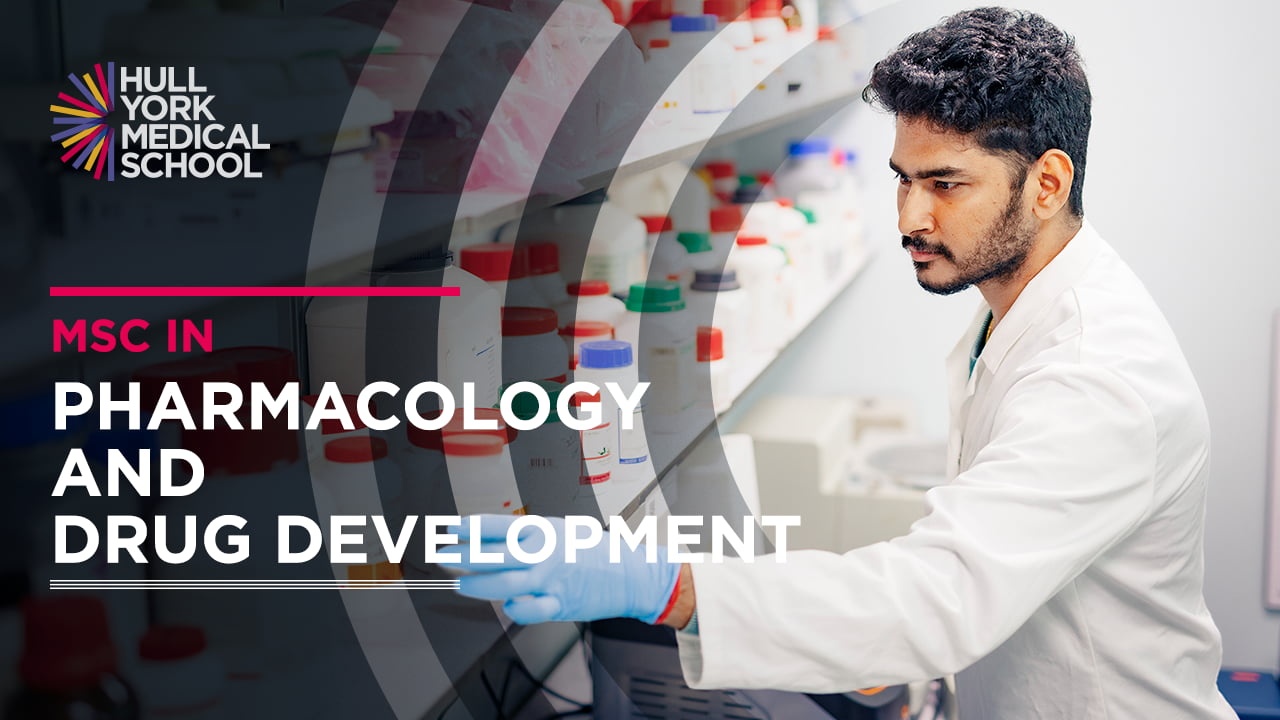
MSc inPharmacology and Drug Development

Course length

1 year full-time,2 years part-time

Start date

September 2026

Location

Hull campus

Apply now

About the programme

Our MSc in Pharmacology and Drug Development will provide you with unique and unrivalled opportunities to immerse yourself in the clinical, basic science and industrial aspects of pharmacology – to ultimately push the boundaries of contemporary knowledge in pharmacology and drug development.

Pharmacology explores how drugs interact with biological systems. It plays a vital role in understanding the effects, mechanisms, and therapeutic uses of medications across a wide range of healthcare fields, including medicine, nursing, dentistry, and veterinary science.

By studying pharmacology, we gain insights into how drugs are developed, how they work in the body, and how they can be used safely and effectively to treat diseases. This knowledge is essential for advancing medical research, improving patient care, and shaping the future of healthcare.

On this course, you will gain the skills to play an active role in developing the next generation of drugs – either from first principles in the lab, testing in clinical trials, or taking new products to clinic.

You will understand the fundamental principles of pharmacology and the clinical relevance of drugs for the major organ systems, whilst demonstrating the drug development process, from initial drug design to understanding the importance of clinical trials.

You will have regular contact with an industrial mentor through our unique partnership with health and nutrition company Reckitt, as well as access to their state-of-the-art Science and Innovation Centre in Hull, and sessions delivered by industry employees alongside university colleagues.

You may also be interested in our MSc in Pharmacology and Education, a unique course that combines modules from the MSc in Pharmacology and Drug Development with our Higher Education Academy-accredited MSc in Health Professions Education.

Who is this programme for?

MSc in Pharmacology and Drug Development is aimed at applicants from a wide range of backgrounds, including clinical, pharmaceutical, biomedical, life or basic sciences, to create a unique, stimulating and collaborative environment. If you are a highly motivated, inquisitive student, looking to push the boundaries of contemporary knowledge in pharmacology and drug development, whilst at the same time extending yourself and boosting your career opportunities in a high achieving academic setting, then this programme is for you.

This programme is an ideal option for intercalation. Read on to find out more.

Meet the Programme Director

Book a one-to-one online chat with Programme Director Dr Nguok Ngie ("Eunice") Su to learn more about our MSc in Pharmacology and Drug Development. Get the answers to your questions about the course, studying at Hull York Medical School, support, finance and more.

Book a meeting now

Pharmacology and Drug Development

Watch:

Discover Pharmacology and Drug Development

Course overview

2 mins

A different kind of medical school

Our school

5 mins

University of Hull - Hull York Medical School

Webinar

Discover Pharmacology and Drug Development

Wednesday 24 June, 18:00 - 19:00

Whether you're a prospective student or currently preparing your application, this webinar is a fantastic opportunity to learn more about the content of our Pharmacology and Drug Development course, how it's taught, and the exciting career development opportunities on offer.

You’ll also have the chance to speak directly with the Programme Director, Dr Nguok Ngie ("Eunice") Su and get answers to your questions.

Register now

Industry experience

Industry partnership with Reckitt

Through our partnership with leading global health, hygiene and nutrition company Reckitt, you will gain real-world insight into the pharmaceutical industry.

Hull is home to Reckitt's global centre of excellence for health, where they research, develop and manufacture iconic brands, including Gaviscon and Nurofen.

Our collaboration provides you with an understanding of the entire development journey of a clinical drug during your studies – from ‘bench to bedside’ and beyond.

Through this partnership, you will:

  • Have regular contact with an industrial mentor from Reckitt
  • Take tours of Reckitt’s state-of-the-art Science and Innovation Centre in Hull
  • Attend taught sessions delivered by industry experts from Reckitt

Our students find this insight and experience invaluable in preparing them to join the pharmaceutical industry.

Why Pharmacology and Drug Development at Hull York Medical School?

Our Reckitt partnership gives you regular contact with an
industry mentor and access to their state-of-the-art facilities
Gain insight into real live clinical
trials through the Hull Health Trials Unit
Learn from leading scholars and practising experts
with clinical, industry and educational backgrounds

Modules

The programme is a 180 credit Masters programme, with six taught modules (five core and one optional - 20 credits each), and a core research project/dissertation (60 credits).

All modules are subject to availability and this list may change at any time.

Filters

  • Foundations of Pharmacology

    You will learn, discuss, and critically analyse key pharmacological topics such as the general principles of drug action, pharmacodynamics, pharmacokinetics, and adverse drug reactions which underpin the drug development process.

    Core

    20 credits

  • Practical Research Skills in Pharmacology

    Experimental pharmacology goes hand in hand with the need to develop practical lab skills.

    Core

    20 credits

  • Bench to Bedside I: Design and Discovery

    Examine the work that goes on before a drug is given to humans. This will include learning the core concepts of drug design, from target selection, through in vitro and appropriate testing and thinking about the most suitable formulation.

    Core

    20 credits

  • Bench to Bedside II: Clinical Trials

    You have designed a drug – but what next? This module will give you a detailed overview of clinical trials.

    Core

    20 credits

  • Drug Regulation

    Get hands-on experience understanding the key role that regulations play in the drug development process, from initial discovery and pre clinical studies, through clinical trials, obtaining marketing authorisation and post-marketing activities.

    Core

    20 credits

  • Dissertation

    In this phase of your studies, you will get the opportunity to put your new skills to the test by undertaking a substantive research project within the field of pharmacology to produce novel exciting data, with the opportunity to publish the results.

    Core

    60 credits

  • Therapeutics

    The use of drugs underpins modern medical practice. Explore the use of drugs in cardiovascular, cancer, gastrointestinal, renal, respiratory, rheumatological, and endocrine disease as well as areas of uncertainty around the prescription of medicines.

    Optional

    20 credits

  • Analytical Skills in Pharmacology

    Gain experience of specific analytical laboratory techniques as a means of illustrating key techniques used within the process of drug development.

    Optional

    20 credits

University of Hull - Hull York Medical School

Teaching and assessment

How is the programme taught?

You will be based in our Centre for Biomedicine and benefit from their academic, educational and industrial expertise, as well as being taught by scholars from departments such as the Hull Health Trials Unit and other leading clinical and industrial experts. You will receive high quality tuition into the principles and process of clinical trials, covering a range of crucial topics including study rigour, participant recruitment, data analysis and interpretation and appropriate regulatory and governance issues associated with modern clinical trials.

We place an emphasis on helping you to develop the self-directed learning skills that will equip you for lifelong learning and future employment, as well as allowing you to flourish academically in your programme.

With our philosophy of research-led teaching, you will be taught through a combination of practicals, lectures, seminars, tutorials and independent study. Some of these sessions may be online, whilst others will involve external speakers. This combination of different teaching activities allows you to broaden and deepen your learning around the topics in this programme.

You will explore how the pharmaceutical industry works via one-to-one sessions with a pharmaceutical tutor, a site visit, and seminars delivered by experts from pharmacological industry.

You will finish your year with us by conducting a significant research project in either basic or applied pharmacology to generate novel and cutting-edge research findings. The project, which can be lab or non lab based, will be supported by clinical and industry supervisors in the Centre for Biomedicine, which has a strong record of producing 3/4* publishable work.

Teaching and assessment

How is the programme assessed?

Assessments take place throughout your programme and include oral presentations, essays, portfolio, practical write ups, poster presentations, and project work. Details of these are included with the module information.

There are two types of assessment:

  • Formative assessments: These are designed to provide you with an opportunity to obtain helpful feedback to enable you to develop your understanding of the both the type of assessment and the topic. They do not contribute to the final award mark.
  • Summative assessments: These assessments count towards the final module mark. They take place during and towards the end of each module. Feedback will be given for these assessments to help you understand the mark obtained and help with your academic development.

HULL YORK MEDICAL SCHOOL Stories

I was able to work with Reckitt’s medical affairs team and gain an insight into how a pharmaceutical research project is approached from an industrial perspective. The breadth of content and information you are exposed to on this programme sets you up for absolute success within the pharmaceutical industry. I have gone into my role with a great foundation of expertise in all areas of pharmaceuticals, making me a knowledgeable employee who is ready for anything.
MSc Pharmacology and Drug Development graduate

Alanis Beckitt

About the programme

Career prospects

This MSc equips you with the key skills essential for effective design, delivery and interpretation of laboratory and clinical data. This skill set is key for multiple roles within the industrial, medical and academic sectors, both in the UK and internationally.

Within industry, this MSc is likely to open job opportunities in drug safety, quality, regulation and compliance as well as Consumer Safety, Quality Managers, Clinical Data Associate, or Clinical Data Managers, alongside the more traditional lab roles. You will also develop the skills to further your academic career by pursuing a PhD.

In this video, three of our graduates give an insight into their jobs with our industry partner Reckitt in a variety of specialisms, including consumer safety, clinical data, and research and development lab roles.

Intercalation

An ideal option for intercalation

The MSc in Pharmacology and Drug Development will help give intercalating medical students a deeper understanding and appreciation of prescribing.

In the medical sector, an intercalating MSc can have a significant impact on your application to deaneries and your potential career prospects. Understanding the science of medicines improves prescribing and can also open up career opportunities including Medical Advisors.

Discover intercalation
University of Hull - Hull York Medical School

entry

Entry requirements

Applicants must have previous training in the life sciences (e.g. graduates from medical, biomedical, pharmacy or biological undergraduate courses), Chemistry/Pharmacology or other related fields with a minimum 2.2 (Hons) degree or equivalent.

Intercalating medical students must have successfully completed a minimum of three years of an MB BS or comparable medical qualification.

English language requirements

Applicants whose first language is not English must have one of the following:

  • IELTS: 6.5, with no less than 6.0 in each component
  • PTE Academic: 61, with no less than 55 in each component
  • CAE and CPE (from January 2015): 176, with no less than 169 in each component
  • TOEFL: 87, with a minimum of 21 in each component
  • Trinity ISE: level 3 with Merit in all components
  • LangCert B2 Communicator High Pass (minimum score 33/50)
  • WASSCE: C5

Applicants who do not meet our English Language requirements may be required to complete the University of Hull’s Pre-Sessional English course as a condition of their offer to study on the programme.

Fees and funding

Tuition fees

Fees listed are for 2026 entry. Fees are reviewed on an annual basis and may change for subsequent years.

The level of fee that you will be asked to pay depends on whether you're classed as a UK (Home) or International (including EU) student. Check your fee status on the University of York website.

UK (Home)

  • Full-time: £13,900
  • Part-time (2 years): £6,950*

International (including EU)

  • Full-time: £32,900
  • Part-time (2 years): £16,450**

*The fees listed for part-time study relate to the current year only, fees for subsequent years are subject to confirmation.

**The part-time study option is only available to international students who do not require a visa to study in the UK.

Applicants who are self-funded and assessed by the University of Hull as paying the overseas tuition fee rate are required to pay a non-refundable deposit at the point of offer. A place will not be guaranteed until the full deposit has been received. The University reserves the right to stop accepting deposit payments once course places are full and, as a result, may defer an offer to the next available intake. Find out more about the University of Hull Tuition Fee Deposit.

Funding

There are a number of funding options available to help with costs and support your postgraduate study. To apply for funding, you will need to hold an offer to study at Hull York Medical School.

Postgraduate Taught Widening Access Scholarship

The Widening Access Scholarship, offered as a £4,800 fee reduction, is available to two UK applicants who meet our eligibility criteria.

Hull York Medical School Postgraduate Taught International Excellence Scholarships

Two International Scholarships, offered as a 20% reduction in tuition fees, are available to eligible applicants.

Graduate scholarship

A 10% reduction in tuition fees is available to graduates of the University of Hull and University of York.

Hull York Medical School Intercalated Student Bursaries

We offer two bursaries worth 50% of the tuition fee to intercalating Hull York Medical School MB BS students who meet widening participation criteria.

Intercalated Student Bursary

Two £2,400 bursaries are available for intercalating Medicine students from other UK medical schools who meet our eligibility criteria.

University of Hull - Hull York Medical School

Applying

How to apply

To apply, submit an online application on the University of Hull website.

You don’t need to complete your application all at once - you can save and finish it later.

Apply now

The deadline for applications from international applicants is 10 August 2026, and 17 August for home (UK) applicants.

HULL YORK MEDICAL SCHOOL Stories

The MSc in Pharmacology and Drug Development will give you an in-depth knowledge of drug development within an academic, clinical and industrial setting. This critical mix of knowledge and interaction with our expert teachers will open exciting opportunities to broaden your career prospects.
Programme Director

Dr Nguok Ngie Su

Further information

Explore more

Join the postgraduate newsletter Subscribe now